My travels is all about... My views, thoughts and experiences on/about/at/with random places of interest, persons, things, events, issues etc,. I am an eternal student with a restless mind and a tumultuous heart!

Tuesday, January 14, 2020

Vikrama's lesser known temple

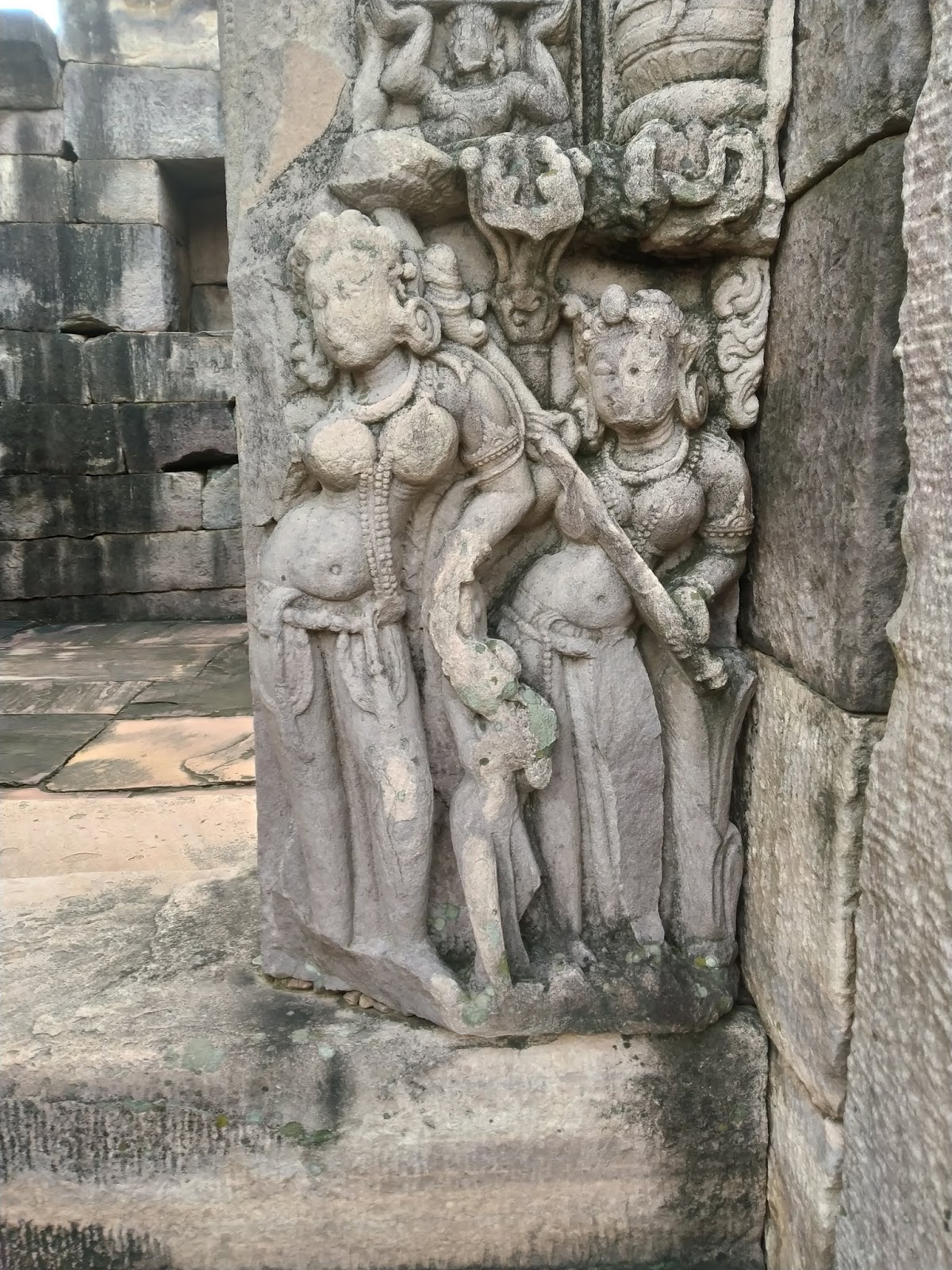
Vikramaditya VI (r.c.1076-1127 CE) is widely regarded as the greatest of Western Chalukyas. His reign is marked by the beginning of the Chalukya-Vikrama Era (c.1079 CE ?), and his celebrated patronage of arts and architecture. Temples and Inscriptions (often exaggerated) attributed to his grandeur dot the length and breadth of the modern Indian state of Karnataka. He Patronized poets like Bilhana (author of Vikramanakadeva Charitam). Kamaleshwara Temple/Iswara temple, located at Jalasangvi of Humnabad Taluka, Bidar District of Karnataka is one of the temples attributed to his reign. The temple pales in comparison, in terms of sheer size, with other celebrated gems of Chalukya-Vikrama Era (Itagi, Bellary etc,.). But, the sculptural excellence achieved here in carving various Madanika/Apsara/Salabhanjika Bracket figures is extraordinary, and is a precursor to the celebrated sculpture of later day Kakatiya and Hoyasala temples.

Jalasangvi Iswara/Kamaleshwara Temple

Madanika playing with Parrot

I had the blessed opportunity to visit this serene and simple temple during one Sunday of January, before the Sankranthi festival chaotically translates into a sensory over-drive. From the central bus station of Bidar, the city of whispering monuments, I took  Humnabad bus to Jalasangvi Cross road for a charge of Rs.55/-. The journey took almost 40-45 minutes. And from the cross road, a gentleman on bike dropped me off at the temple, which is just 10 minutes away, located in the interior of the village.

Sculpture - at the temple
AshtaBhuja Ganesha

I'm largely disappointed with the lack of awareness regarding this historical temple. Not even a single information board is set here to enlighten an enthusiastic tourist. Yet the sculptures speak to your soul! The temple is built on a star shaped raised platform - an attribute gleefully embraced by later day Kakatiyas. As I made the Pradakshina, I noticed the brilliantly carved Gods and Apsaras - Lord Vishnu, Lord Shiva, Goddess Rakta Kali/Chamunda, Goddess Durga flanked by beautiful Madanika/Apsaras as bracket figures. A rare sculpture of 8 headed Ganesha (Ashta Bhuja Vinayaka) flanked by the piece de resistance of the temple - Shilabalika/ShasanaSundari/Patralekhini i'e 
A graceful & mythological apsara/madanika drafting an eulogising epigraph on her patron, Vikramaditya VI is extraordinary. The lovely lady inscribes what appears to be Sanskrit words in early Kannada Script - 'Saptadveepodaree Bhutam Bhutalam Sweekarishyati Chalukya Vikramaditya Saptamo Vishnuvardhanaha' i.e, 'Vikramaditya of Chalukya Dynasty captured and is ruling the land containing seven islands'.

Shasanasundari

Now was that eulogy true? Don't know.
Was it exaggeration? Maybe. 
But is it beautiful? Definitely yes.


12 January 2020.
Jalasangvi.   

Tuesday, December 31, 2019

My 2019


In the cold winter mornings, seeds of self doubt crept into my numbing mind,
a new year began – the last in the decade of an ever testing kind.
Great enthusiasm matched with even greater failures,
But life went on, unaware of the abyss that lurks and lures.

A self realized lust for travel intertwined with a curious quest;
I journeyed into the ancient realms of yore, at my humble and humorous best.
I was a part of a raging huge crowd, yet I prized my solitude.
Between beautiful dreams and harsh realities, I moved seamlessly with a weird attitude.

What changes now? Nothing but a new calendar and a fancy new year with a rhythmic zing,
New experiences - some good, some bad, - to be faced without a sting. 
But, all the lessons learnt would not be forgotten, as I bid adieu to the bygone year;
and start afresh - my flirty tryst with twenty twenty, old and wise but still so young and foolish - with a silent cheer!


Saturday, December 14, 2019

The Enlightened One

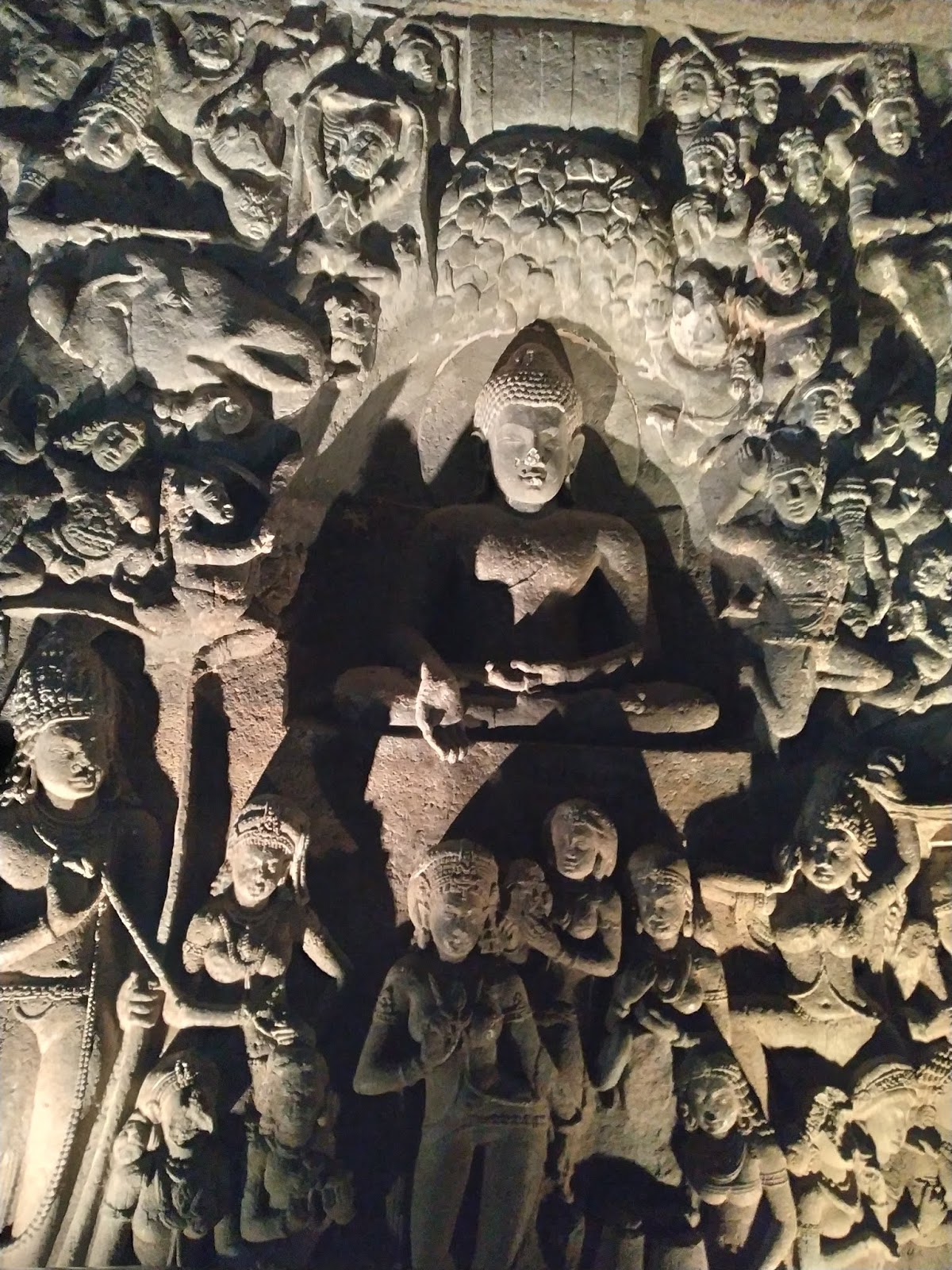
Temptations of Mara Panel - Gautama Buddha in Bhumisparsha Mudra, cave 26 of Ajanta - c.5th Century CE

(Based on the 'Temptations of Mara' panel inside Cave 26 - dated c.5th Century CE, of Ajanta Caves, Maharashtra,  which depicts Gautama Buddha in his famous 'Bhumisparshamudra', in deep penance, ignoring the threatening goblins and the tempting daughters of the demon Mara)

An army of goblins created a reckless ruckus,
their shrill deafening voices filled with ugly roughness. 
Curses, trumpets and drums failed to dampen the spirit
of the lone mortal, set to attain a blameless merit.

To that man, an avalanche of slander meant nothing.
Then - bejeweled and bewitching, they apperared, dipped in beauty, shaking;
the beautiful daughters of the great demon set to entice him,
yet they've failed beautifully, their pride taking a nasty skim.

At the cusp of glory, the man waited and bid his time,
Neither temptations nor warnings could dampen the ambition so selfless and prime.
Centuries later;
when pressures all around seize my senses, I think of this panel -  
of the enlightened one, the mortal turned divine, before I turn into a vandal.


Monday, November 11, 2019

there would never be another Seshan...

TN Seshan in 1994 (File Pic), Wikipedia

A nation of millions shook in the nervous nineties -
in an era of political gimmicks punctured by electoral malpractices.
But one man rose from the corridors of power,
and an institution was rebuilt from scratch, so the corrupt could cower.

Cards of Identity to the embattled voters;
the good changes invited crass curses from those with vested powers.
Pitched battles were fought for the victory of truth, in consecutive annals;
Be it Punjab or Bihar - the commission's word was perfectly final.

A culture of adherance to rules began on the high altar of democracy -
for once, the dumb millions shook with happy pride despite the official obstinacy.
Elections will come and go like seasons; - mother nature's variation
but there would never be another Seshan for this gigantic nation!


Tirunellai Narayana Iyer Seshan (1932-2019), popularly called TN Seshan was the tenth Chief Election Commissioner of India (1990-96) whose adherence to rules, style of functioning and electoral reforms are a stuff of legends - under him, the Election Commission of India became one of the glorified Constitutional institutions running on the pillars of Transparency and Accountability, winning universal public acclaim and respect, but also earning him brickbats form unscrupulous elements (i.e, the political class who always bent the rules during elections)
https://en.wikipedia.org/wiki/T._N._Seshan 
Picture above - Credits to Rishabh Tatiraju from Wikipedia

Sunday, October 20, 2019

An old man's cry in the wilderness

(c.1748 CE - On his death bed, Asaf Jah 1, founder of the Hyderabad state warned his sons and grandsons not to fight among themselves, to be pious and vigilant, to take good care of the people and be wary of the machinations of the European companies. However, his successors precisely did everything against his advice - they were always engaged in bitter succession disputes, took help of French and British companies in battles & family feuds, led extravagant lives in sharp contrast to the vast majority of people.

His sagacious advice was only an old man's cry in the wilderness.

In the words of Asaf Jah 1.....) 


Tomb of Nizam ul Mulk I/Asafal Jah I at a Dargah in Khuldabad. 

"
My dear sons! My mundane time is up and the other world calls me,
my power and pride have evaporated, and I'm a dying tree.
Pardon this foolish old man, but pay attention to my words,
For these words would guard you better than the Persian swords.

Let there be no quarrel amongst you, be a band of brothers,
have faith in unity; patience and piety would do you wonders.
Never indulge in bloodshed merely for the lust of conquest,
reign with a gentle heart and vigilant mind, as if on a spiritual quest.

Beware of the merchant companies from the sea,
be wary of their profits and their plans; far from us let them be.
Reject the sweet words of the sycophants,
seek truth and reward it, and be prepared for history's taunts.

To the people - be an indulgent father; not a punishing despot.
for all their troubles - be a genuine source of respite.
Victory and defeat greeted me equally in my life, for I was rigorous.
Do not ignore my words; lest they become an old man's cry in the wilderness.
"


Mir Khamruddin Khan Siddiqui Bayafindi (c.1671-1748 CE), more popularly known by his titles -Asaf Jah I /Nizam Ul Mulk I/Chin Qilich Khan was a famous Mughal nobleman. He went on to establish the modern state of Hyderabad in 1720 CE. His life is like a roller coaster of victories and defeats.

Saturday, October 5, 2019

Andhra's own Kalinga - Srimukhalingam

My brother at the temple      
Srimukhalingam temple complex
Main Shrine entrance

(June 2019)....Srikakulam, the northern most district of Andhra Pradesh is home to many Ancient Hindu temples and Buddhist ruins. The Sun Temple at Arasavelli, the Kurmanatha temple (Shri MahaVishnu as Kurma Avatar) at Srikurmam and the Srimukhalingeswara swamy (Lord Shiva) temple of Srimukhalingam - these three constitute a special and the most popular group of temples here. The architectural achievements of the Eastern Gangas of Kalinga (Early Medieval age -c.?-15th Centuries) are tremendous. But, even before Konark and Puri became the glorified synonyms of Kalinga's architecture, there was Srimukhalingam. Kalinganagara - the modern day village of Srimukhalingam in Jalamuru mandal of Srikakulam district was the first capital of Eastern Gangas.

A Warrior

Carving of Apsara

Dedicated to Lord Shiva, Srimukhalingeswara swamy temple is perhaps the only monument of Andhra Pradesh in Kalinga architectural style, untainted by later additions. The remote location of the village adds a sort of 'Je ne sais quoi' to the temple's already ancient ambiance. The Shiva Linga has a distinct carving of Lord Shiva's face, hence the name 'Sri Mukha Lingam' (Telugu - The Linga with the Lord's face) is apt. In fact, a legend explains that the Linga had it's origin from a Madhuca tree (Madhuca Longifolia) trunk. In terms of architectural style, the monument is perhaps the first of it's kind - an artistic experiment of the Eastern Gangas, who later perfected it at Jajpur, Bhubaneshwar, Konark and Puri.

Carvings on wall

The large temple complex is built in Trikuta plan - three separate shrines of Madhukeswara, Bheemeswara and Someshwara temples on a common raised platform. The Carvings on the temple walls show signs of brilliant worksmanship. The sad fact of this place is, and I regret as I type this, the low-key maintenance of the temple and the apparent emotional blackmailing by some priests for money, which I did not find at any other temple, till date. Another disappointing factor is the long and weary road - small, dreadfully deserted and full of cracks as if it were the cricket pitch on 5th day of a test match.

Carvings on outer entrace

Yet, it remains a great place with an element of mystery and history combined - for example, sample this fact - Historians know that Kamarnava II of Eastern Gangas built the temple. But they could not exactly date this temple - 8th Century? 11th Century? 10th Century? Or let it reamain a mystery till we get hold of conclusive evidence....

The temple


Road to Srimukhalingam

Thursday, September 26, 2019

A coward's march to victory...

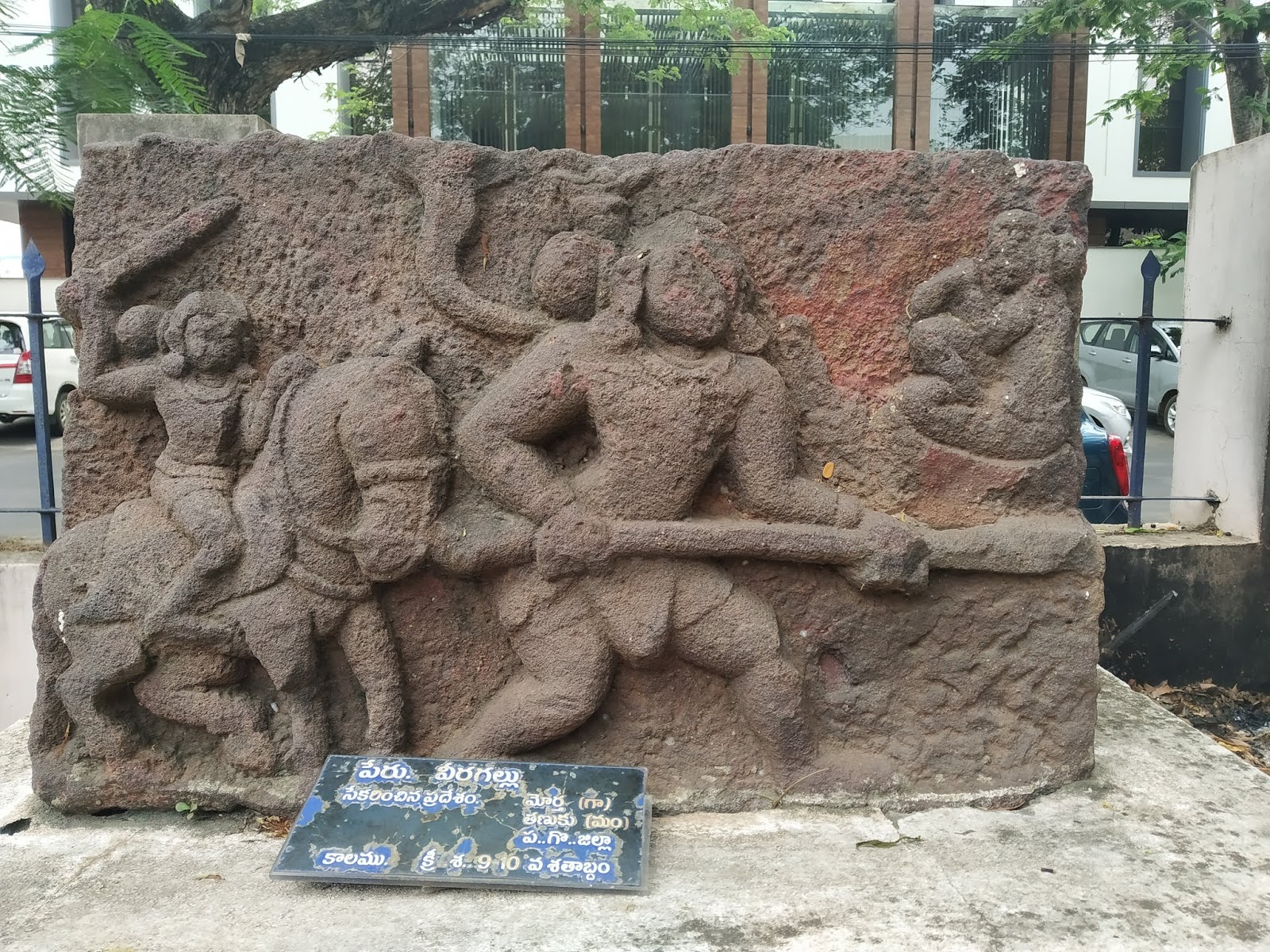
(For almost 500 years, the dynasty of Eastern Chalukyas ruled from Vengi, Bikkavolu and Rajamahendravaram - all in modern day Andhra Pradesh. Most of the time, they were forced to play second fiddle to competitors like Cholas, Western Chalukyas, Eastern Gangas, Rashtrakutas and were relegated as tax paying feudatories.Yet, for some brief time during the 9th Century, facing insane odds, their greatest emperor Gunaga Vijayaditya rose to prominence, which gave a semblance of respect to them. Gunaga's generals went on to defeat Rashtrakutas, subdjugate rebel feudals and these 'Chanda Chalukyas' had no opponent from Pulicat Lake to the Vindhya mountains. But, Gunaga had a rough beginning - he had to face a civil war against rival claimants and relatives. Initially, he had to flee the kingdom and wandered as a depressed coward with little hope, waiting and waiting...In his own words)

Warriors (Stone/Rock) - Eastern Chalukyas - Kakinada Museum

I wonder why 'Victory' was added to my name, and I never tasted even a little success?
A cruel joke of destiny, that's played on me, a petty pawn in the game of chess.
I'm cast away like a shipwrecked man, and I thought I was a Prince loved by all.
Now, I realize they only lust after power, and I'm just a pampered naive doll.

Armies of all kingdoms from all directions raid our beloved cities for tributes and glory,
But our forces only take sides in disastrous succession battles - what a  tomfoolery!
My ancestors held lofty titles - all nice lies, their bulging fragile egos overspent...
And here I am, their grand successor, wandering in forests, pursued by my own men.

An uncertain life of a Prince in exile - that's what that's before me,
A clueless coward or a cunning conspirator ? Right now, I'm just a survivor per se,
My life is in dark, let the dawn come and I'll live through hell if need be,
Let the beasts of the forest be a testimony of this coward's march to victory!

One of the ruined temples supposedly built by Gunaga Vijayaditya at Bikkavolu (c.9th Century CE)

Thursday, September 19, 2019

In and around Tadipatri - The hidden gems of a forgotten empire

Inside Chintala Rayaswamy Temple, Tadipatri


Mini Carving at Chintala Rayaswamy Temple, Tadipatri

A consistent rain coupled with vast landscapes of broken slabstones and carved hillocks greeted me on my one day sojourn to Tadipatri and surrounding places. If the historian Robert Sewell passionately called the Vijayanagara Empire (c.1336-1670s CE) as 'The Forgotten Empire', then the temples of Tadipatri could very well be the hidden gems of a forgotten empire - these could escape the destruction brought on Hampi after the Battle of Tallikota (c.1565 CE), yet remain passively outside the scope of fame attained by the magnificent ruins of Hampi.

Sculpture inside Bugga Ramalingeswara Temple, Tadipatri

Salabhanjika Sculpture, Bugga Ramalingeswara Temple

Tadipatri
Tadipatri (Literally Palm Leaf in Telugu) is located in Anantapur district. During the glory days of Vijayanagara Rayas, their feudatories - Pemmasani Nayakas controlled the town and it's surrounding areas. Two temples built by these feudatories survive to this day. The first one, originally planned in 14th Century CE and dedicated to Lord Shiva is the Bugga Ramalingeswara Swamy Temple. Two half-built gopurams adorn this brilliant temple located on the banks of River Penna. The Sculptures, especially the welcoming Salabhanjika lady on  the archways of the temple gopurams is wonderfully detailed. On one of the walls, we could distinctly observe the Imperial Royal Insignia of Vijayanagara Empire.


Imperial Royal Insignia of Vijayanagara Empire inside Bugga Ramalingeswara Temple, Tadipatri
Chintala Rayaswamy/VenkataRamanaswamy Temple is built as per Vaishnava tradition, and is dedicated to Lord Venkateswara. Just like the Vijaya Vitthala temple of Hampi, there is a Garuda Ratha here too i.e, Stone Chariot. And akin to the ruined Hazara Ramalaya of Hampi, the walls of the temple have mini carvings and engravings of tales from Ramayana. The temple is thus, simply a sublime architectural tribute to those two fantastic yet ruined temples of Hampi. Watching the black granite sculptures set in a gentle drizzle - that's a brilliant experience.

Garuda Ratha - Stone Chariot at Chintala Rayaswamy Temple, Tadipatri


At Chintala Rayaswamy Temple, Tadipatri

Yaganti
11 kms away from Banganapalle of Kurnool district, Yaganti is famous for it's two temples and three caves. Although originally a Chalukyan site, the place rose to prominence during the reign of Sangam Bukka Raya I of Vijayanagara Empire. A huge pond (Koneru), a supposedly ever raising stone Nandi (Bull, vahana of Lord Shiva) are the major attractions at the Uma Maheswara (Shiva) temple located here. Sankara Cave, associated with cult of seer Potuluri Veerabhrahmendra Swamy (the Telugu Nostradamus) and a shrine dedicated to Lord Venkateswara within a cavern are other major places of interest. Set amidst Reddish Sandstone hills, Yaganti offer a glimpse of glory to nature lovers.

Nandavaram
I did not intend to see any other place, but got to visit this place on a whim. Located 10 kms away from Banaganapalle on Nandyala road, the village has a famous temple dedicated to Chowdeswari Devi, a local cult deity. A ruined temple dedicated to Lord Shiva is another interesting temple here.

Koneru at Yaganti Uma Maheswara Temple  

Tips
1. I started from Banaganapalle. Tadipatri is 66 kms away from Banaganapalle and is well connected by busses. Enroute, Belum Caves and Owk Resorvoir are other place of interest. However, I could not visit them.
2. Yaganti is located 11 kms away from Banaganapalle in a different route and share autos ply from the latter. The frequency of busses is bad. Nandavaram is located on Nandyala route and is well connected by busses from Banaganapalle.

Beware
1. Banganapalle railway station is located very far away from the town's centre and is very difficult to reach.
2. Unfortunately, sudden and heavy rains lashed these areas during the past two days. 

Agasthya Mandapa at Yaganti

Venkateswara Shrine, Yaganti

Thursday, September 12, 2019

Bhopal


Begum Shah Jahan of Bhopal - a progressive ruler famous for emphasis on Women's education, economy and beautification of Bhopal City
  

Bhojeswara Temple, Bhojpur near Bhopal

For Mahadev, the poet loving Paramara Rajput dreamt of a temple so huge,
the monument's unfinished but to the legacy, a crowning glory ensued.
On the banks of the Bhojtal, a city was born,
as little birds chirped and common-folk lived without scorn.

Taj Ul Masajid - largest masjid in India

For Hundred years, the Pashtun Begums reigned with a progressive hand,
with people as sole priority - a template that set the law of the land.
Women illuminated the Pari Bazaar as grand mosques were built, 
opulence and simplicity went hand in hand, with a sarcastic tilt.

Golghar Museum on Bhopal State (c.1707-1949 CE)

To the tribes of the nation, a great museum paid awesome tribute,
but in terms of public transport, there is much to be desired - just plain truth.
Heavy rains battered down on the city during my visit,
yet, it remained calm and firm with a charm so implicit.

A typical home of  Naga tribe - Inside Indira Gandhi Manav Sangrahalaya


Bhopal
Located on the banks of the Bhojtal Lake, the city of Bhopal is the capital of Madhya Pradesh. It has a past that harks back to Paramara Rajputs. For almost 100 years during Mughal & British Indian eras, the city was ruled by a succession of progressive minded Begums belonging to Orkhazai Pashtun tribe. Bhojtal Lake, Bhojeswara temple of Bhojpur, one of India's largest mosques - the Taj ul Masajid and perhaps the only museum of it's kind - Indira Gandhi Manav Sangrahalaya within Van Vihar National Park are some of the city's awesome places of interest.


Sheer artistry at sublime Sanchi...where the north and south first met!

Sanchi Sthupa no 1

In 3rd Century BCE, Asoka the Great was in a dilemma. He wished to start a grand Buddhist Establishment - one that would survive for centuries. The site so selected must ensure seclusion and solitude befitting monastic life, yet it should also be close to the Imperial Capital, old highway and preferably near to a rich and populous city.

The Emperor's selection was spot on - Vedisagiri, the present day Sanchi Hill!

At a ruined monastry

The present day village of Sanchi is located 7 kms away from Vidisha. The Sanchi Hill, with it's two Sthupas and ruins of monastries and temples is at a distance of 1.5 kms from the village's bus stop. The Village is regularly connected by busses from Vidisha and Bhopal. The entrance fee to visit this world heritage site is Rs.25/- for Indians, and the charge includes a visit to the Interpretation Centre/Museum on the hill too, which would be closed on Fridays.

An Inscription on stone

What to see? Sthupa no.1 is simply an exquisite masterpiece! Originally built as a brick Sthupa by Asoka the Great, many additions and embellishments were made to this in the later days by Sungas, Guptas and Satavahanas. The Sthupa has entrance archways on four directions, with lavish ornamentation in stone - the best in India! Tales from Vessankara Jataka, mythical creatures like Griffin, King Prasenajit of Shravasti etc are depicted in stylish panels with astounding detail. On a railing near the Eastern archway, a Sanskrit grant inscription was engraved by the Gupta Emperor Chandragupta II Vikramaditya in Golden Hue (c.410 CE). On the top portion of the Southern archway, there is another famous inscription in Prakrit Brahmi - that of Satavahana ruler Satakarni I (Chanda Siri Satakarni) - hence this is where the north and south first met! Sthupa no.2 located 1 km away from the main Sthupa has many motifs and carvings, although not as lavish as that of Sthupa no.1. Apart from these two sthupas, there is a minor Sthupa, ruins of temples and monastries built much later. Just outside the main entrance, there is a Chaityagriha built by Srilankan monks that has the relics of Sariputta & Moggallana.

Sanskrit Inscription of Chandragupta II Vikramaditya in c.410 CE, Eastern Archway, Sthupa no 1

A Script was deciphered! Many Pillars and stones here contain characters/minor inscriptions in Prakrit Brahmi. After a detailed study of these, the Brahmi script was finally deciphered by a British Indian Mint Officer James Princep. All these inscriptions end with the word 'Dana' i.e, donation - in two charachters - this working hypothesis became the basis for deciphering an entirely unknown script!

Credit must be duly given to the plethora of British archeologists who rendered yeoman service to this site (Sir Alexander Cunningham, Captain Taylor, James Princep etc), and it must be mentioned here that the Nawabs and Begums of Bhopal took great care in scientific protection of this site after it's rediscovery in 19th Century.

Under the Lioned Capital Pillar - Sthupa no 1

Sanchi holds a special place in Indian History. It was here that the north and south first met. It was here that the futility of war was reiterated giving way for the love of humanity and the victory of Dhamma!

Centre - King Prasenjait of Shravasti out for a walk, Below - Pipal tree worship