My travels is all about... My views, thoughts and experiences on/about/at/with random places of interest, persons, things, events, issues etc,. I am an eternal student with a restless mind and a tumultuous heart!

Saturday, May 31, 2025

కొండపల్లి

(కొండపల్లి కోట, నవంబర్ 2023) 


కోట వద్ద నేను

కృష్ణానదికి ఉత్తరాన, విజయవాడ నగరానికి పశ్చిమంగా కొండపల్లి అనే గ్రామముంది. ఇక్కడికి దగ్గర లోనే    తూర్పు కనుమలు, కళింగ ఖరవేలుడు 'కన్నబెన్న' నదిగా అభివర్ణించిన కృష్ణానదిని  తొలిసారి  ముద్దాడాయి, మరియు గోదావరి-కృష్ణా డెల్టా ప్రాంతం ముగిసింది. ఈ గ్రామం పొనికిచెట్టు కలప నుంచి తయారు చేసిన కొండపల్లి బొమ్మలకు, గ్రామపేరు తోనే వున్న కొండపల్లి కోట / ఖిల్లా కు సుప్రసిద్ధి. కొండవీడు కోట తో సమానమైన ప్రశస్తి కలిగిన ఈ కోట తెలుగు వారి మధ్యయుగ చరిత్ర తెలుసుకోవడానికి ఉపయుక్తం. 

శిథిలాలు 

ఈ కోట కాకతీయులపతన కాలానికే  (1323 CE) వున్నది అన్నది నిర్వివాదాంశం. ఆ కాలం లోనే ఈ కోట  ఓం ప్రధమంగా ముదిగొండ చాళుక్యులు, ముసునూరి నాయకులు వంటి  సామంత రాజ్యాలు, చిన్న చిన్న స్వాతంత్ర్య రాజ్యాల స్వాధీనంలో వుండేది అని శాసన సాక్ష్యం. 14 వ శతాబ్దంలో ప్రోలయ వేమారెడ్డి రెడ్డి రాజ్య స్థాపన తో ఆంధ్రదేశం లో ఒక నూతన సూర్యోదయం మొదలయ్యింది. ఇదే కాలం లో ఆంధ్ర దేశ మధ్యభాగాముగా, కొండపల్లి వాసికెక్కింది. అటు తర్వాత కళింగ సూర్యవంశ గజపతులు, గోల్కొండ కుతూబ్షాహీలు, మొగలాయిలు, హైదరాబాద్ నైజాం సంస్థానానికి చెందిన అసాఫ్ ఝాఈలు వరసగా కొండపల్లి ని ఏలారు. చివరకు బ్రిటీష్ వారి హయాంలో కొండపల్లి సైనిక అవసరాలకు స్థావారంగా (Garrison) గా మారింది.                                               

కుతూబ్షహీల శాసనం 

'ఖగపతుల్, నరపతుల్, గజపతుల్ సాగించిరి సమరము' అని ఒక మధ్యయుగ కవి తెలిపినట్టుగా,  పదిహేనవ శతాబ్దం లో బహమనీలు, గజపతులు, విజయనగర సమ్రజ్యాధీశుల మధ్య మొదలైన త్రైపాక్షిక రణం లో కొండపల్లి ని వశపరుచుకోవడం కీలకమైంది. మొదటగా, సూర్యవంశ గజపతి కపిలేంద్ర దేవుని కొడుకైన హాంవీరదేవ రౌత్రాయా కొండపల్లి ని జయించాడు. సుమారు అర్ధ శతాబ్దం తర్వాత, తన కళింగ జైత్రయాత్ర లో శ్రీ కృష్ణదేవరాయలు, కొండపల్లి కోట ని ముట్టడించాడు. గజపతుల కళింగ రాజ్యానికి కొండపల్లి సుమారు నూరు ఏళ్ళ పాటు దక్షిన సరిహద్దు అయ్యింది.  

కోట ద్వారం

నేడు శిథిలమైన కొండపల్లి కోట అత్యంత సుందరమైన ప్రకృతి వడి లో, పచ్చని చెట్ల మధ్య, పూర్వ వైభవం కొదవైనా విరాజిల్లుతోంది. కోట ని రెందు విధాలు గా చేరుకోవొచ్చు - మొదటగా కొండపల్లి గ్రామము ప్రధాన వీధి (కొండపల్లి బొమ్మల చేతిపనివారి ప్రధాన వీధి) నుంచి కొండ వెనకవైపు గా కాలిబాటన ఒక దారి, రెండవది, ఇబ్రహీంపట్నం నుండి రోడ్డు మర్గాం ద్వారా. శిథిలమైన బురూజు దర్వాజాలు రెండు, గదుల తో వున్న తనీషా రాజభవనం, చెరసాల, అత్యంత గంభీరంగా, గత వైభవాన్ని చాటుతూ స్వాగతిస్తాయి. రాష్త్ర ప్రభుత్వం ఎప్పటినుంచో కొండపల్లి కి విశేష జనాదరణ కల్పించాలి అని కృషి చేస్తొంది. ప్రభుత్వ నూతన పర్యాటక విధానం ఈ దిశగా ఒక మంచి అడుగు.


కొండపల్లి బొమ్మ 


కొండపల్లి 

మహీత్ వెలువలి,
16 సలాది జమీందార్ వీధి , పాలకొల్లు ,.
31 మే , 2025.


The Hill Fort

(Kondapalli Fort, November2023) 


Me at the Fort

To the north of river Krishna, to the West of the city of Vijayawada, lies the village of Kondapalli, literally meaning hill village / hamlet / settlement. The irregular Eastern Ghats touch the banks of River Krishna, and the fertile Godavari-Krishna Delta ends here. The village is noted for Kondapalli Toys, sourced from local soft wood called Tella Poniki. It also houses the eponymous Fort of Kondapalli. Together with Kondaveedu Fort, it is a well noted Fort of Andhra Pradesh, that harks back to Medieval ages.

Ruins

The fort had humble origins, and was reportedly in existence during the fall of the Kakatiyas in c.1323 CE. Sources attribute it to various fighting factions and feudal dynasties viz, Mudigonda Chanakyas, Musunuri Nayakas. During 14th Century CE, a new dawn arrived in Andhra Desa, however shortlived. Under Prolaya Vema Reddy, the Independent Reddi Kingdom emerged and Kondapalli's stature rose, as a central location of Telugus in an increasingly fragmented polity. The next centuries lent much credence to Kondapalli's prominence, as Suryavamsa Gajapatis of Kalinga held sway, followed by Qutubshahis of Golconda, short lived Mughal Suzerainty, AsafJhais (Nizam) of Hyderabad, and eventually,  the fort turned into a military bastion and garrison under the British.  

A Qutub Shahi Inscription

In 15th Century, when the tripartite struggle peaked between the Bahmani Sultanate, Rayas of Vijayanagar and Suryavamsa Gajapatis of Kalinga, Kondapalli changed hands frequently, and was initially captured by Hamvira Routraya of Kalinga, feat replicated half a century later by Sri Krishna Devaraya in his famed Kalinga campaign (c.1513-1520 CE). Kondaplli marked the Southern extent of Gajapatis. 

Entrance to Fort

Today, the ruins and ramparts of the fort offer a picturesque site, and it is accessible on foot from the village of Kondaplli through the Toys Street,  as well as by road from Ibrahimpatnam, with the Ghat road dotted by Quarry lorries on a long queue. The Darwazas, ruined Jail Khana, Tanisha Palace with chambers, offer a sombre sight, pointing to a lost era. There is a huge scope for development, and the State Government of Andhra Pradesh has taken due note of it, vide it's new Tourism Policy. 


Kondapalli Doll


The Hill Fort

Maheeth Veluvali,
16 Saladi Jamindar Street, Palakollu,.
31st of May, 2025.


Saturday, May 24, 2025

The 'Jewel Box' of Agra

Tomb of Itimad Ud Daula

 (Tomb of Itimad Ud Daula, Agra, Uttar Pradesh - March 2023)

The itinerary that was supposedly planned for me by the auto wallah was modified with my caveat - that I'd like to visit the tomb of Itimad Ud Daula. From the perspective of Agra Cantonment Railway Station (locally called 'Chavani'), and regarding tourists in general, this monument is usually skipped as people remain in perpetual awe and throng the Taj Mahal in droves ignoring other lesser known places. It is located across the Yamuna river, a bit far from Agra Fort and the Taj Mahal. The auto passed through the dusty lanes of Agra, bypassing sweet shops selling Petha. Agra wasn't modern in any sense, and the civic amenities are found lacking. And, one fine late March morning, I stood before the Tomb of Itimad Ud Daula, and I was the only visitor there.

Me @ Tomb of Itimad Ud Daula
 

There are three iconic monuments of Mughal Architecture, primarily and loosely based on the Tomb of Tamelane in Uzbekistan :-

1. Tomb of Humayun

2. Tomb of Itimad Ud Daula

3. The Taj Mahal 

@ Tomb of Itimad Ud Daula
 

The first two were commissioned by women and the third was in memory of a woman. The tomb of Itimad Ud Daula, built between 1622 and 1628 CE, was commissioned by Nur Jahan, Consort of  Emperor Jahangir, in memory of her father, Mirza Ghais Baig, a noble who started his career under Akbar, the Great. The noble was honoured as 'Itimad Ud Daula' i.e, "pillar of the state".  The building, essentially a mausoleum, marks a paradigm in Mughal architechture, as the Red Sandstone was replaced by White Marble. By early 17th Century, the Mughals were an established power in North India, with their confidence aided by imperial consolidation reflected in their buildings.

@ Tomb of Itimad Ud Daula
 

The mausoleum's exterior is betrayed by it's rich interior. The European technique of 'Pietra Dura' was first applied here, wherein exquisite precious stones and gems were used in creating beautiful paintings and decoration, often embellished in the form of flower vases, symmetrical objects etc,. The minarets and the overall façade point to a methodical and mathematical precision. Few years later, the tomb would inspire the Taj Mahal, now a Wonder of the World. Verily, it stands up to the moniker, ‘Baccha Taj / Baby Taj’ and ‘Jewel Box’.   


Pietra Dura Work @ Tomb of Itimad Ud Daula


The 'Jewel Box' of Agra

Maheeth Veluvali,
16 Saladi Jamindar Street, Palakollu,.
24th of May, 2025.

Wednesday, May 21, 2025

The Birth of Pax Magadha

Dad @ the iconic rock cut elephant, Dhauli

(Dhauli, Bhubaneshwar, Odisha, 
November 2021)

The Afternoon Sun was merciless upon us, menacing with a dash of urgency, even though it was November. 8 Kms to the South of Bhubaneshwar diverted from the oft taken Puri Road, lays the hallow ground of Dhaulagiri, the legendary battleground of India's most famous Ancient War. Dhauli / Dhaulagiri now houses an Asokan rock Edict, a rock cut Elephant and a new, large Buddhist Shanti Sthupa. 

In 261 BCE, the Mauryan Emperor of Magadha, Asoka the Great, as per his own recorded inscriptions, defeated and annexed Kalinga, with one decisive final battle at Dhauli / Dhaulagiri (?). After the bloody battle, the Emperor, dejected with violence, increasingly took solace in Hinyana Buddhism, and pursued the concept of Dhamma with a renewed zeal, and became a Pacifist, as per Buddhist tales. Modern day historians are more balanced, and view Asoka's Dhamma as merely an extension of his Statecraft, a tool to consolidate his empire, albeit with peaceful means and within practical ends. A code of conduct was envisaged for people and officials, and ostentation and rituals were frowned upon, as Asoka, being a 'Benevolent Despost', was stretching the Chanakyan adage of 'King as a Father to his subjects' to it's most logical extent.   

"The beloved of the Gods declares that victory of Dhamma (Righteousness) to be the true victory" proclaims the victorious emperor's Rock Edict XIII at Dhauli, now protected. A rock cut elephant, perhaps, the first of it's kind in the Sub Continent welcomes one to the site. Today, the small hills and nearby meadows are peaceful, as people visit the Dhauli Shanti Sthupa located nearby. I looked around, and wondered aloud, as to what would inspire men to take up arms, and wage great battles? Under the weight of the titles of Kings, How did the common man fare and suffer? How could abstract concepts and material pursuits combine to create bouts of war and peace?  Doesn't Time destroy everything? Centuries thence, empires of yore crumbled into obscurity, in what way? Perhaps in the words of Ernest Hemingway, "gradually and then suddenly."     

Dhauli forms a lesser known part of the East Indian / Odisha Triangle comprising Puri, Konark and Bhubaneshwar. Yet the place's significance cannot be missed, for it marked the death of a war and the birth of Pax Magadha....  

Dhauli Shanti Sthupa


The Birth of Pax Magadha

Maheeth Veluvali,
16 Saladi Jamindar Street, Palakollu,.
21st of May, 2025.

Tuesday, May 20, 2025

The Benevolent Ugra Narasimha

@ Lakshmi Narasimha Temple, Hampi

 
(Group of Monuments at Hampi - Vijayanagara, Vijayanagara District, Karnataka 
December 2024)
 
"Это Вишну
This is Vishnu"
A lively group of Russian tourists passed by on foot, when their guide finished description of the Vasihanava Insignia including Sudarshana Chakra and Panchajanya Conch in Russian. It was already late in the evening and we were exploring Hampi-Vijayanagara, the once crowned capital of Vijayanagara Samrajyamu, noted for it's grandeur and splendor, the likes of which the naked eye has never experienced, to quote Abdur Razaq, the Persian Safavid Ambassador in early 15th Century.

The Group of Monuments at Hampi is an iconic international tourist destination - one that beckons to the glory days of Vijayanagara Era (c.1336-1565 CE). One of the iconic monuments is an Idol.  

This so called Ugra Narasimha Idol is dedicated to Lord Sri Maha Vishnu in his Narasimha Avatar (Man-Lion). Hindu Scriptures speak of the devout Prahlada, who invokes Lord Sri Maha Vishnu. The Great God appeared in his Narasimha Avatar and slew Prahlada's father, the embodiment of  evil, Rakshasa Hiranya Kashyapa. As per an adjacent inscription, the idol was the sole surviving part of the Lakshmi Narasimha Temple, commissioned by Krishna Bhatt, in c.1528 CE on the express instructions of the greatest Vijayanagara Emperor, Sri Krishna Devaraya. One would be amazed at the gulf between reality and perception - the idol is wrongly but popularly mentioned as Ugra Narasimha, with Ugra referring to fierce, but is originally Lakshmi Narasimha i.e, Narasimha with his consort, Goddess Lakshmi Devi.
 
The badly damaged Idol, the chopped off limb that could at one point of time seated Goddess Lakshmi Devi, could be due to the disastrous sack of Hampi after the Battle of Tallikota (c.1565 CE). The idol is located adjacent to the Bhadava Linga, a large Linga partially submerged in a well like small temple. "Bhadava" in Kannada means poor and the name ascribes to the installation of the Linga by a poor woman, but that is a tale for a different day!
 
The Benevolent Ugra Narasimha stood the test of time, although bereft of his beloved consort, continues to awe admirers from centuries and far off places, and would continue to do so.......


The Benevolent Ugra Narasimha

Maheeth Veluvali,
16 Saladi Jamindar Street, Palakollu,.
20eth of May, 2025.

Friday, December 27, 2024

Tribute to Sri Manmohan Singh

Dr Manmohan Singh Ji with Sri P V Narasimha Rao JI


"History will be kinder to me" - Dr Manmohan Singh Ji (January 2014)

Dawn brought with it the sad news of the demise of Dr Manmohan Singh Ji. For a man who disliked Politics and yet was a Member of Rajya Sabha for over three decades, and an economist who served all top finance related posts in Republic of India, his life remained a contrast of humility and economic excellence. His role as our Prime Minister is much studied, maligned and poorly resembles a film that has a decent first half and a disastrous second half. In unshackling the reins of the Indian economic giant and waking it out of the Quota Raj induced stupor, his role as Finance Minister, although in near past is sweeter. 

As he humbly quipped, two phone calls spaced 15 years apart went on to change his life, and the fate of our country, if that is not so much of an overstatement. The first one made him the Finance Minister and the second and more popular one was in 2004. In his illustrious life, Dr Singh straddled with ease as an Economist, Educator, Bureaucrat and Political Statesman. He was mocked for his silence and the so called Policy Paralysis (2011), but he could address the most troubling and gargantuan press conferences with ease and grace. Under his watchful gaze, India reinforced her place as the World's fastest growing economy, pulling the 123 Deal with USA. A slew of welfare measures marked the reformer's era, but alas there was always much to be desired. A dash of courage and creativity perhaps... 

As I am from Andhra, I've seen his wish of Special Status to the residuary state of Andhra Pradesh (Rajya Sabha Statement, February, 2014) wither into a cruel call in wilderness - was that a genuine concern or simply wishful thinking of a work in progress politician - no one knows. Three decades prior, his Political mentor Sri PV Narasimha Rao Ji, famously quoted in USA -  "Not being a historian, I am under no obligation to remember the Cold war, and I'd skip it." But, in Dr.Singh's case, it's a twist of fate that a great political statesman looks to history for some genuine appreciation. And, he deserves our respect.


Tribute to Sri Manmohan Singh 

Maheeth Veluvali,
16 Saladi Jamindar Street, Palakollu,.
27th of December, 2024.

Thursday, November 14, 2024

A Winter's Day

It's a Winter's Day - that lazy, listless, lethargic season; 
Dull yet dreamy, all cravings unwritten.
How great a dream is to remain unbothered, 
yet it's a dutiful regular day, like any other.

Gentle drops of snow dancing in the morning,
playing hide and seek with the rays of the Sun;
A perfect recipe for Solitude's yearning -
Alas; but work bothers us all with a Gun.

The days may be short, but our memories aren't;
The show goes on for the men in the arena. 
A crisp chilly sojourn before Summer dawns, 
As for the rains, they never left anyway. 

The Divine aura of Kartheeka sweeps the Hills and the Plains, 
As festivals of fervor make their mark. 
In winter's warm embrace, we mark our gains, 
But, hey - tomorrow's another winter day - no less shiny, no less dark. 


"A Winter's Day" (Poem / English) 
Maheeth Veluvali, 
16 Saladi Jamindar Street, 
Palakollu. 
Thursday, 14th of November, 2024.

Sunday, October 27, 2024

The Last Great Living Chola Temple....


Me at the Periya Nayaki Shrine

September 2023 - Airavateswarar Temple, Tarasuram (Outskirts of Kumbhakonam), Tamil Nadu

Rajagambhira Mukhamandapam

The Airavateswarar Temple of Tarasuram, dedicated to Lord Shiva as Airavateswara, is the third, last and latest temple forming part of the Great Living Chola Temples - a UNESCO World Heritage Site and a fine specimen of Chola Temple Architecture. It was constructed during the rule of Raja Raja II (r.c.1146-1172 CE), in c.1166 CE. Although the Imperial Cholas ruled a vast area, their glory days of Raja Raja I and Rajendra I seemed to be far behind. Tarasuram stands adjacent to Kumbhakonam (20 minutes away), the latter known for it's Coffee, Educational Institutions and Temples, and is well connected by privately operated busses and autos. In fact, from the Central Bus station of Kumbhakonam, Adi Kumbheswarar Temple, Sarangapani Temple and Tarasuram are located on the same route.

A Mural

The temple is square-planned, and once boasted seven streets (ala Srirangam), and is mythologically associated with the tale that Airavata, the White Elephant - Royal mount of Lord Devendra, once cursed, prayed Lord Shiva, and dipped in the temple tank for absolution. The legend is still venerated as people dip in the temple tank, whose waters are replenished by the adjacent Cauvery River. The temple's plan is based on the chariots / cars which are used in procession of deities. The main temple possesses the Rajagambhira Mukhamandapam - the finest Chola Mandapam. Of particular interest is the World's first optical illusion in stone - Rishabha Kunjaram - a beautiful amalgamation of the heads of the Bull and the Elephant - which are repliacted later on in the temples at Ontimitta (Kadapa) and Hampi-Vijayanagaram. An adjacent Subsidary Shrine is dedicated to Goddess Periya Nayaki. 

Rishabha Kunjaram - World's first optical illusion in stone

The Arga Mandapa has the so called singing steps - a wonder that's found in some Medieval Era Temples. As is the case with Tamil Saiva temples, the images of the Nayanars are found along with tales depicting their lives. Niche carvings of Ardhanadheeswara, Gaja Lakshmi adorn the Vimana. The temple, in terms of pure architecture, may not match the grandeur of the more popular Brihadisvara Temples at Thanjavur and Gangaikonda Cholapuram, but, sculpturally and aesthetically, is a class of it's own, with beautiful images and standardized Pillars. It is truly the last great living Chola temple. 

Ardhanadheeswara Niche Carving


"The Last Great Living Chola Temple" - on The Airavateswarar Temple, Tarasuram
16 Saladi Jamindar Street, Palakollu
Sunday, 27th of October, 2024.
Maheeth Veluvali.    

Sunday, October 13, 2024

The Sun Temple

 
The Jagmohana of Sun Temple, Konark

"Here, the language of Stone surpasses the language of man."
- Gurudev Rabindranath Tagore (c.1861-1941 CE) on The Sun Temple of Konark.
 
Langula Narasingha Deba I receiving African Merchants' Gift (Giraffe) - Arkha Kshetra

I have had the pleasure and honor of visiting the Sun Temple at Konark thrice (June/July 2019, November 2021 and June 2024) and it is a peerless experience. The Sun Temple of Konark is a ruined temple dedicated to Lord Surya / Lord Arka, the Sun God, located in the coastal town of Konark in Puri District of Odisha. It is the pinnacle of Kalinga Architecture and the most iconic monument of Odisha. The town and the Kshetra finds mention in the Brahma Purana as Konaditya, Arkha Kshetra, Padma Kshetra and in the Periplus of the Erythrean Sea as Kainapara. It is also associated with the legend of Samba's Curse in Bhagavatam and Mahabharatam. The temple in it's current state, owes it's existence to 'Langula' Narasingha Deba I, the King of Eastern Gangas who ruled from c.1238 CE to c.1264 CE. He succeeded his father, Anantavarman Chodagangadeba, of the Puri Jagannath Temple fame, and was consumed by a burning desire to match his father in construction zeal.

Crocodile consuming Fish themed faucet - Chhaya Devi Shrine

The main temple, completed c.1250 CE, was planned as the Chariot of Lord Surya, complete with Seven Horses and 24 Chakras i.e, spoked wheels, each divided into 8 equal parts representing Praharas i.e, divisions of time. Three separate icons, denoting Early Morning, Afternoon and Evening represent Lord Surya. Chalcolite, Khondalite  and Granite, sourced from the Eastern Ghats made up this 13th Century Monument. Some sources state that the Idol was in a suspended state, not touching the ground, owing to usage of Iron and Magnetism. A large Mandapa called the Nata Mandir, full of fantastic figurines of dancers, singers, mythical creatures, Mithun etc., welcomes us, followed by the main temple. It is a pity that only the Jagmohana i.e, Assembly Hall stands today, and the Deula is completely destroyed. The adjacent buildings attached to the temple like Bhoga Mandir, Chhaya Devi Mandir are also ruined. 

Nata Mandir

The recurring theme of Gaja-Simha is an interesting feature. Of the surviving sculptures, an Elephant trampling a condemned man evokes horror and awe in equal measure. At the shrine of Chhaya Devi, the faucet, shaped like a Crocodile eating a Fish seems so lifelike. As to why the temple was abandoned / ignored - mystery surrounds. Many theories exist viz, Invasion and desecration by Bengal Sultanate and later Mughals (plausible but not the only reason), lack of interest shown by successors, an alleged disagreement between the King and his Minister, proximity to Bay of Bengal causing decay, Konark losing it's prominence to Puri and Bhubaneshwar....the list goes on. The fact remains that, at it's prime, the temple was a source of elegance, envy and efficiency, fondly called as 'The Black Pagoda' by foreign travelers and traders.

Sun Temple, Konark

Today, the monument stands, as a UNESCO World Heritage Site, attracting the curious and the devout, a true icon of heritage. Indian Oil Corporation's Arkha Kshetra, an interpretation center offers brilliant insights into the temple and it's hoary past - a matter of pride, pain and passion.

A Chakra @ Sun Temple, Konark

Accessiblity 
Konark forms the Golden Triangle of Odisha / East Indian Tourism circuit, along with Puri (50 Kms) and Bhubaneshwar (60 Kms). It is a Notified Area Council Panchayat, accessible through road from either Puri (via Balukand - Konark Road running parallel to the Bay of Bengal and crossing Chandrabhaga River) or Bhubaneshwar. Tourist busses and Privately operated vehicles operate regularly to and from these three places. Konark also possesses the Chandrabhaga beach, India's and Asia's first Blue Flag certified beach (2018).
 
Us @ Sun Temple, Konark

"The Sun Temple" - on The Sun Temple, Konark
16 Saladi Jamindar Street, Palakollu
Sunday, 13th of October, 2024.
Maheeth Veluvali. 

The Holy Island

Srirangam DivyaDesam - View Point

Formed by rivers Kollidam and Cauvery, the island of Srirangam is located in the vicinity of the city of Tiruchirapally. It is noted for two of the iconic temples, belonging to Lord Sri MahaVishnu and Lord Shiva respectively. 

Golden Vimana of Srirangam DivyaDesam

Sri Ranganatha Swamy Divyadesam 
As per Tamil Vaishnava Sampradaya, Sri Ranganatha Swamy Temple of Srirangam is regarded as Veetu i.e, Home of Lord Sri MahaVishnu, the first and foremost amongst the 108 Divya Desams.  It is one of the largest functioning Hindu Temples of the World, possessing the tallest Gopuram in Asia (The South Tower / Rajagopuram) and is the seat of Tenkalai (literally Southern) branch of Sri Vaishnavism. Historically, all major dynasties of the region have had their distinct imprint on the temple, including Chozhas, Pandyas, Rayas of Vijayanagar et al. The celebrated Bhakti Saint Ramanujacharya, the doyen of Vishistaadwaita is associated with the temple, and his mortal remains are located here. A very large Garuda points to the direction of the Lord, and the idol of Lord Sri Ranganatha, located within seven precincts, is in typical Sesha Sayana form. An interesting feature of the temple is a view point, with a bird's eye view of all 21 Gopurams and Vimanans.
 
Southern Tower / Rajagopuram of Srirangam DivyaDesam

Sri Jambukeswarar Temple, Jambukeswaram / Tiruvanaikoil  
Another iconic temple is dedicated to Lord Shiva as Sri Jambukeswara, a Pancha Bhootha Sthalam / Maha Bhootha Sthalam representing the element of Water i.e, Jalam. It is also a venerated Padal Petra Sthalam. As per legend, Goddess Parvati, as Goddess Akhilandeswari Devi performed a penance to Lord Shiva as a repentance. This large temple is a Padal Petra Sthalam as well, and is located just 2 kms away from Sri Ranganatha Swamy Divyadesam.

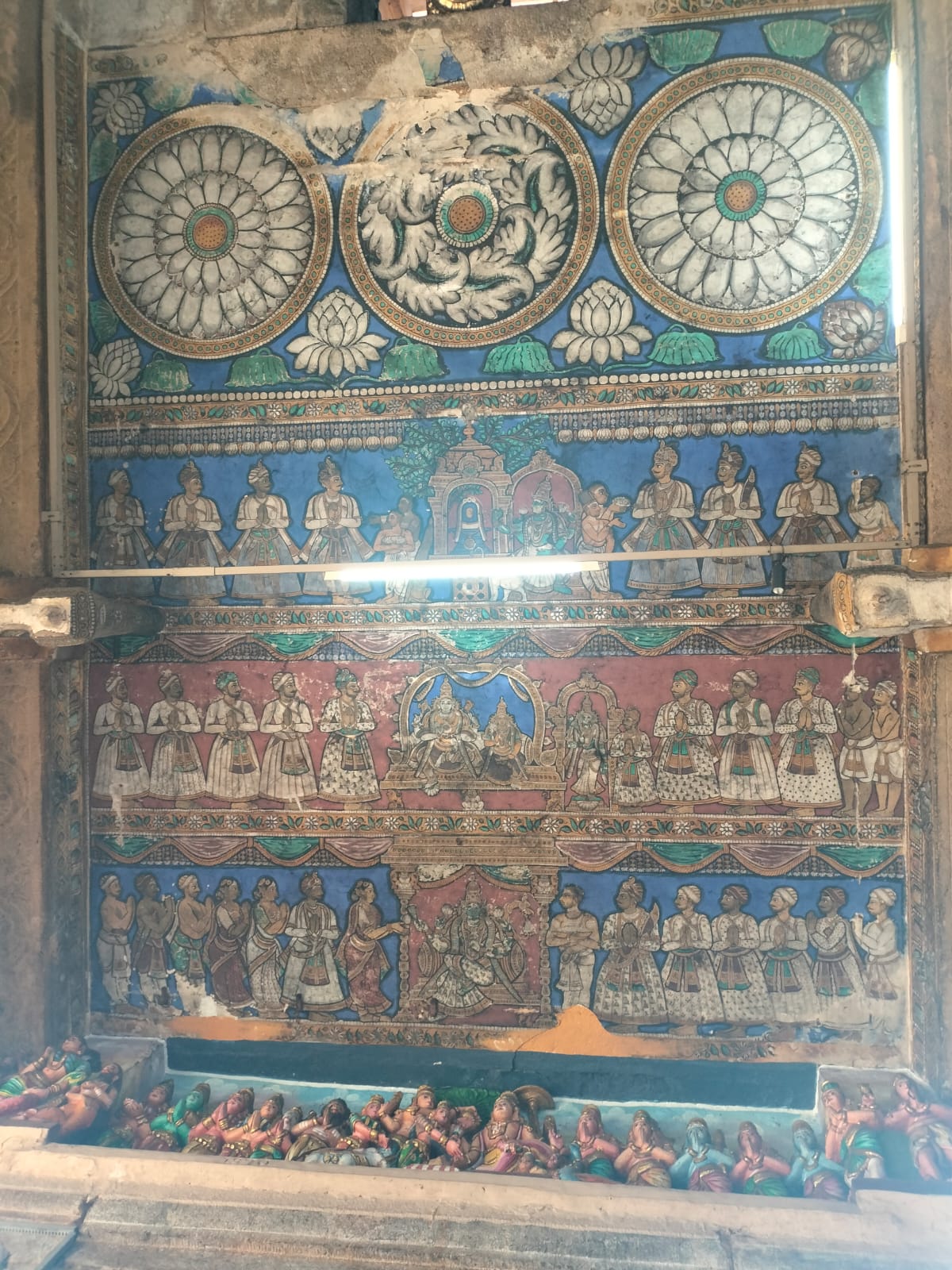
Mural Painting @ Akhilandesari Devi Shrine, Jambukeswaram / Tiruvanaikoil

Accessiblity 
Srirangam has a small railway station, but the nearest Railway Junction is Tiruchirapally Junction, which is well connected to other cities of Tamil Nadu. Srirangam island is around 10 kms away from the Junction Station, and is easily accessible by Privately operated City busses plying through the city of Tiruchirapally connecting it's Central Bus Station with Junction Railway Station, Our Lady of Lourdes Church,  Chatram Bus Stand (Local Bus Stand), Tiruvanaikoil and Srirangam. Busses and Taxi services are also available in Tiruchirapally, which is now popularly referred as Trichy.  
 
@ Jambukeswaram / Tiruvanaikoil

Impressively, but not entirely surprisingly, Srirangam continued to flourish as a holy island, even in the most troublesome times, and would continue to do so in future. 


"The Holy Island" - on Srirangam
16 Saladi Jamindar Street, Palakollu
Sunday, 13th of October, 2024.
Maheeth Veluvali.