My travels is all about... My views, thoughts and experiences on/about/at/with random places of interest, persons, things, events, issues etc,. I am an eternal student with a restless mind and a tumultuous heart!

Showing posts with label Tamil Nadu. Show all posts

Sunday, October 27, 2024

The Last Great Living Chola Temple....


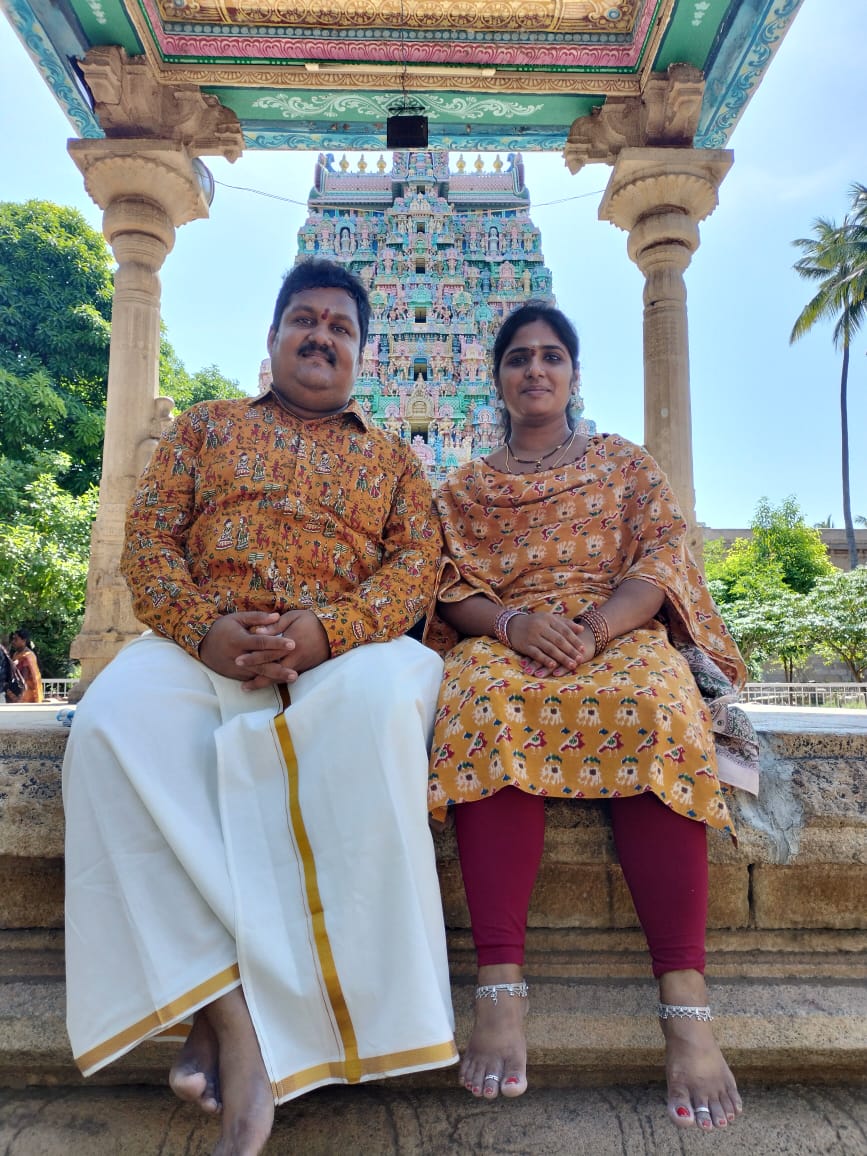
Me at the Periya Nayaki Shrine

September 2023 - Airavateswarar Temple, Tarasuram (Outskirts of Kumbhakonam), Tamil Nadu

Rajagambhira Mukhamandapam

The Airavateswarar Temple of Tarasuram, dedicated to Lord Shiva as Airavateswara, is the third, last and latest temple forming part of the Great Living Chola Temples - a UNESCO World Heritage Site and a fine specimen of Chola Temple Architecture. It was constructed during the rule of Raja Raja II (r.c.1146-1172 CE), in c.1166 CE. Although the Imperial Cholas ruled a vast area, their glory days of Raja Raja I and Rajendra I seemed to be far behind. Tarasuram stands adjacent to Kumbhakonam (20 minutes away), the latter known for it's Coffee, Educational Institutions and Temples, and is well connected by privately operated busses and autos. In fact, from the Central Bus station of Kumbhakonam, Adi Kumbheswarar Temple, Sarangapani Temple and Tarasuram are located on the same route.

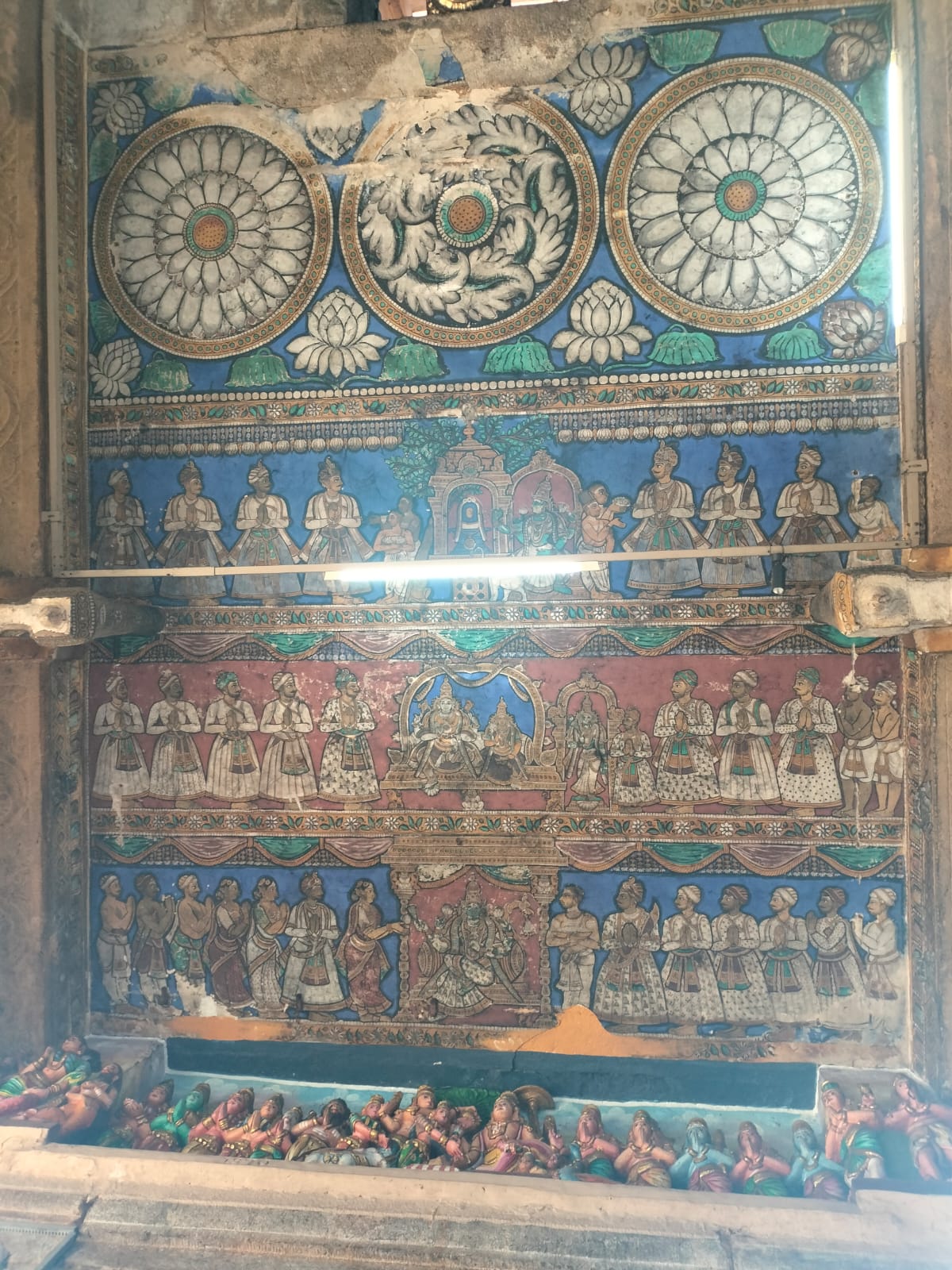
A Mural

The temple is square-planned, and once boasted seven streets (ala Srirangam), and is mythologically associated with the tale that Airavata, the White Elephant - Royal mount of Lord Devendra, once cursed, prayed Lord Shiva, and dipped in the temple tank for absolution. The legend is still venerated as people dip in the temple tank, whose waters are replenished by the adjacent Cauvery River. The temple's plan is based on the chariots / cars which are used in procession of deities. The main temple possesses the Rajagambhira Mukhamandapam - the finest Chola Mandapam. Of particular interest is the World's first optical illusion in stone - Rishabha Kunjaram - a beautiful amalgamation of the heads of the Bull and the Elephant - which are repliacted later on in the temples at Ontimitta (Kadapa) and Hampi-Vijayanagaram. An adjacent Subsidary Shrine is dedicated to Goddess Periya Nayaki. 

Rishabha Kunjaram - World's first optical illusion in stone

The Arga Mandapa has the so called singing steps - a wonder that's found in some Medieval Era Temples. As is the case with Tamil Saiva temples, the images of the Nayanars are found along with tales depicting their lives. Niche carvings of Ardhanadheeswara, Gaja Lakshmi adorn the Vimana. The temple, in terms of pure architecture, may not match the grandeur of the more popular Brihadisvara Temples at Thanjavur and Gangaikonda Cholapuram, but, sculpturally and aesthetically, is a class of it's own, with beautiful images and standardized Pillars. It is truly the last great living Chola temple. 

Ardhanadheeswara Niche Carving


"The Last Great Living Chola Temple" - on The Airavateswarar Temple, Tarasuram
16 Saladi Jamindar Street, Palakollu
Sunday, 27th of October, 2024.
Maheeth Veluvali.    

Sunday, October 13, 2024

The Holy Island

Srirangam DivyaDesam - View Point

Formed by rivers Kollidam and Cauvery, the island of Srirangam is located in the vicinity of the city of Tiruchirapally. It is noted for two of the iconic temples, belonging to Lord Sri MahaVishnu and Lord Shiva respectively. 

Golden Vimana of Srirangam DivyaDesam

Sri Ranganatha Swamy Divyadesam 
As per Tamil Vaishnava Sampradaya, Sri Ranganatha Swamy Temple of Srirangam is regarded as Veetu i.e, Home of Lord Sri MahaVishnu, the first and foremost amongst the 108 Divya Desams.  It is one of the largest functioning Hindu Temples of the World, possessing the tallest Gopuram in Asia (The South Tower / Rajagopuram) and is the seat of Tenkalai (literally Southern) branch of Sri Vaishnavism. Historically, all major dynasties of the region have had their distinct imprint on the temple, including Chozhas, Pandyas, Rayas of Vijayanagar et al. The celebrated Bhakti Saint Ramanujacharya, the doyen of Vishistaadwaita is associated with the temple, and his mortal remains are located here. A very large Garuda points to the direction of the Lord, and the idol of Lord Sri Ranganatha, located within seven precincts, is in typical Sesha Sayana form. An interesting feature of the temple is a view point, with a bird's eye view of all 21 Gopurams and Vimanans.
 
Southern Tower / Rajagopuram of Srirangam DivyaDesam

Sri Jambukeswarar Temple, Jambukeswaram / Tiruvanaikoil  
Another iconic temple is dedicated to Lord Shiva as Sri Jambukeswara, a Pancha Bhootha Sthalam / Maha Bhootha Sthalam representing the element of Water i.e, Jalam. It is also a venerated Padal Petra Sthalam. As per legend, Goddess Parvati, as Goddess Akhilandeswari Devi performed a penance to Lord Shiva as a repentance. This large temple is a Padal Petra Sthalam as well, and is located just 2 kms away from Sri Ranganatha Swamy Divyadesam.

Mural Painting @ Akhilandesari Devi Shrine, Jambukeswaram / Tiruvanaikoil

Accessiblity 
Srirangam has a small railway station, but the nearest Railway Junction is Tiruchirapally Junction, which is well connected to other cities of Tamil Nadu. Srirangam island is around 10 kms away from the Junction Station, and is easily accessible by Privately operated City busses plying through the city of Tiruchirapally connecting it's Central Bus Station with Junction Railway Station, Our Lady of Lourdes Church,  Chatram Bus Stand (Local Bus Stand), Tiruvanaikoil and Srirangam. Busses and Taxi services are also available in Tiruchirapally, which is now popularly referred as Trichy.  
 
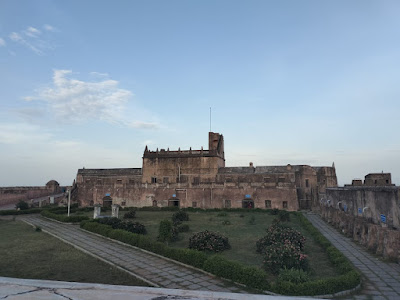
@ Jambukeswaram / Tiruvanaikoil

Impressively, but not entirely surprisingly, Srirangam continued to flourish as a holy island, even in the most troublesome times, and would continue to do so in future. 


"The Holy Island" - on Srirangam
16 Saladi Jamindar Street, Palakollu
Sunday, 13th of October, 2024.
Maheeth Veluvali.

Saturday, August 3, 2024

The Land of Singing Waves


Me @ Tharangambadi Beach

Tharangambadi (formerly Tranquebar), Tamil Nadu - September 2023
In Mayiladuthurai district of Tamil Nadu lies the sleepy coastal town of Tharangambadi (literally, 'The Land of Singing Waves'), that was once Danish East India Company's crowning glory in the Colonial Era (c.1620 -1777 CE). The Imperial Kingdom of Denmark-Norway was also one of the lesser-known protagonists of the 'White man's burden'. However their possessions in India mattered little when compared with the ambitions of the British or the French. 

South Asia's first Protestant Church (?) - Tharangambadi

Fort Dansborg - one of the largest Danish Forts ever built

Fort Dansborg, one of the largest Danish forts ever built is the most recognizable monument of Tharangambadi, her long unutilized little cannons seemingly perched towards the sea, as if thwarting  any competitive economic rival emerging from the Bay of Bengal. Much before the advent of the Danes, the Pandyas and later, Thanjavur Nayaka Kings controlled Tharangambadi. The old Saiva temple (Masilamaninathar) stands to this day, despite the ravages of the infamous 2004 Boxing Day Tsunami. The serene spot could have captivated the Danes, who indulged in business as well as proselytization, eventually 'purchasing' this piece of land from the Nayaka Kings, just like the British in Chennai. Unlike Chennai, Tharangambadi remains a foot note in the pages of history and retains an idyllic charm befitting a benign rural setting. The town also possesses South Asia's first Protestant Church (sic), a Danish-Indian Cultural Centre, and a museum. A walk down this town, soaking in the evening Sun, looking at the old colonial buildings, with the breeze from the Bay, offered a serene refreshment from the routine of the ordinary days - a much-needed break. 

Masilamaninathar Temple (Saiva) - Pandyas - Tharangambadi

Me @ Fort Dansborg

Tharangambadi, formerly Tranquebar, the little Denmark of India, the Indian darling of the Danes in 17th Century, remains 'The Land of the Singing Waves'. 

TownsGate - Tharangambadi
   
Main Street, Tharangambadi


The Land of Singing Waves - on Tharangambadi/Tranquebar
16 Saladi Jamindar Street, Palakollu
Saturday, 03rd of August, 2024.
Maheeth Veluvali.

Tuesday, July 16, 2024

Descent of the Ganges / Arjuna's Penance


@ Descent of the Ganges / Arjuna's Penance

The Descent of the Ganges, also called Arjuna's Penance, a large open air rock relief, is just a stone's throw away from the Bus station of Mahabalipuram / Mamallapuram in Chengalpattu District of Tamil Nadu. It is a UNESCO World Heritage Site, as a part of Group of Monuments at Mahabalipuram. This Great relief is a work of art. Commissioned by the Pallava King 'Mahamalla' NarasimhaVarman I in mid 7th Century CE after his defeat of Chalukya Pulakesin II, carved by Mandhatar, a renowned sculptor, the relief is the pinnacle specimen of the then workmanship, skill and human endeavor. Measuring 96*43 feet (29*13 m), and spread over two adjacent monolithic rock boulders, it is the largest open air bas relief in India. 

@ Descent of the Ganges / Arjuna's Penance

What does the relief mean? There are two different interpretations to this -
Firstly, it depicts the legendary Descent of the Ganges, wherein ascetic Sage Bhagiratha pleases Lord Shiva to bring forth waters of river Ganges onto the Earth. This feat is watched by Celestial beings of heaven, all sorts of wild animals. Infact, the carving of life size Elephants along with calves in terrific. A lengthy opening between the two boulders contains Naga images, representing the river in a crafty and creative way. Incidentally, this is the most accepted and popular interpretation. 

Another interesting interpretation is based on the celebrated Epic Mahabharata and Bharavi's Sanskrit treatise, Kiratarjuneeyam. As per this, the ascetic in question is not Bhagiratha, but Arjuna, who went on to attain the Divine Weapon, Pasupata-Astra from Lord Shiva. 


In the bottom central portion of the relief, a Cat tries to copy the ascetic's penance to lure any nearby rodents - a humorous Panchatantra tale that warns people to be wary of false ascetics. Further, Sage Agastya is also shown along with disciples, near a small shrine. This is another creative allegory - Agastya is regarded as destroyer of the demon Vatapi in Hindu lore, an attribute with which 'Mahamalla' NarasimhaVarman I would associate, as Vatapigaikondan i.e, Conqueror of Vatapi (Vatapi was also called Badami - the capital of Chalukyas).  


Whatever be the interpretation, Descent of the Ganges / Arjuna's Penance continues to capture the attention and admiration of the masses and scholars alike!


   "Descent of the Ganges / Arjuna's Penance" 
   16 Saladi Jamindar Street,
   Palakollu. 
   Tuesday, 16th of July, 2024.
   Maheeth Veluvali